




Science research
Enzymes
Enzymes were introduced into cleaning products in the early 1960s and are widely used in modern day detergents for their versatility, safety and low environmental impact, as they enable a detergent to remove stains at low temperatures.
Enzymes correspond to protein molecules that act as catalysts to accelerate a biochemical reaction. In the detergent industry, they help the breakdown of larger molecules (present, for example, in a stain) into smaller fragments, which can easily be removed by other ingredients present in the detergents formulation.
Due to these properties, commercial enzymes are used in detergent products to provide a higher degree of stain removal, whiteness, fabric and colour care and overall cleaning performance. Moreover, enzymes will remove stains at lower temperatures, which in turn minimises energy consumption linked to the cleaning process.
Enzymes in detergent products are versatile, beneficial and safe.
Enzymes are used in everyday applications
Enzymes are protein molecules that are present in all living cells. Enzymes are versatile and indispensable in many applications in the food sector (to process dairy), the manufacturing of textiles (for fabric finishing) and in detergents and cleaning products. Enzymes produce no hazardous waste and are fully biodegradable.
Enzymes are safe in use
Enzymes meet the needs of modern society for convenience without compromising health and safety. They have a long history of safe use in detergent products. Allergies among consumers to enzyme-containing laundry and cleaning products have not been reported for over 50 years. Evidence involving many thousands of consumers has shown that the use of enzyme-containing detergents does not result in sensitisation to enzymes.
Stain removal is essential for a circular economy
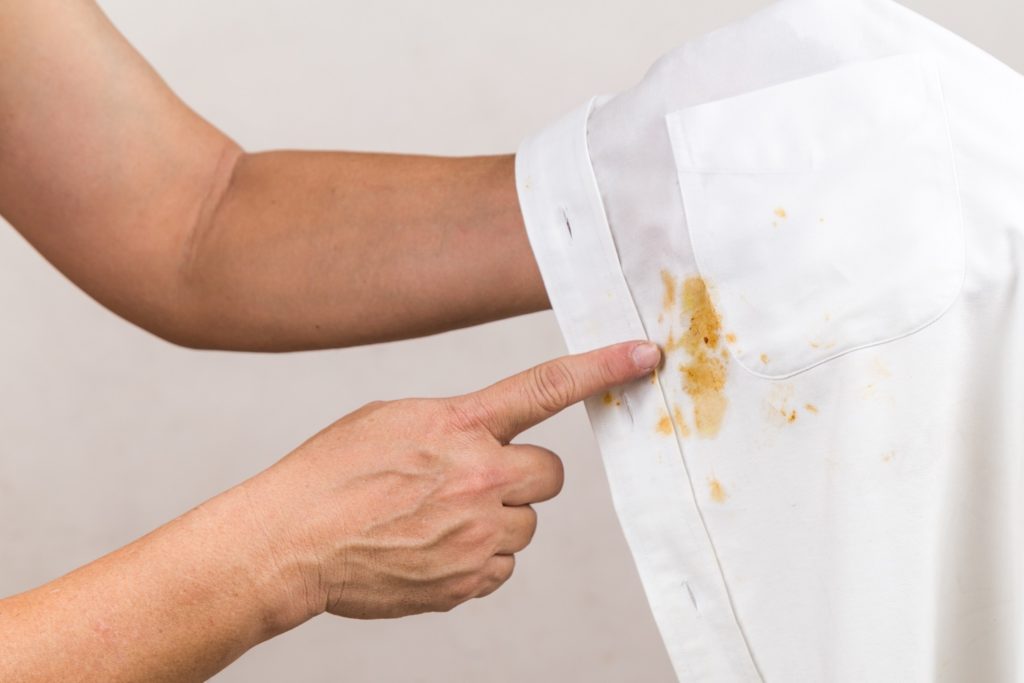
Enzymes have an essential function to effectively eliminate stains from fabric, allowing us to maintain and use our clothes for longer.
Left: Stain of tea with milk on a white shirt washed with a detergent without enzyme.
Right: Same stain removed in a single wash with the same detergent using a protease enzyme.
Enzymes enable sustainable cleaning habits
Enzymes perform stain removal at low temperatures, making them a key contributor to sustainable cleaning habits. The most energy-intensive phase of doing the laundry or dishes is heating the water, but enzymes enable perfect washing results at low temperatures. In addition, compacted enzyme-based products need fewer other raw materials and therefore have a lower environmental footprint.
Safe handling of enzymes
Enzymes meet the needs of modern society for convenience without compromising health and safety. They have a long history of safe use in detergent products, and risk assessments are carried out as part of product development. Encapsulation of enzymes within a formulated product provides maximum safety for the user.
Safe handling procedures during manufacturing are part of the industry’s guidance to ensure minimal exposure. As with other chemical ingredients, the safe handling of enzymes during manufacturing is important because, if inhaled in their raw state, enzymes may cause respiratory allergy in the same way as other allergens such as pollen, house dust mites and animal dander.
Detergents Europe has developed multiple tools to support companies in the safe use of enzymes. While primarily aimed at the detergent industry, the principles of the tools are generally applicable to enzyme-handling applications in other industries.
Industry guidance for safe handling
The industry has developed guidance and other tools to ensure the safe handling of enzymes. This work has been done in collaboration with the Enzyme Manufacturers Association (AMFEP), as well as coordinated on a global basis with the American Cleaning Institute (ACI) and the Household and Commercial Products Association (HCPA). While primarily aimed at the detergent industry, the principles of the tools are generally applicable to other enzyme-handling occupations. The tools to download below include
Guidance on safe use
Risk assessment guidelines
Operational guidance for third parties
Workplace posters on safe handling
Training material
Guidance for the Risk Assessment of Enzyme-Containing Products for Professional Cleaning
How enzymes are regulated in Europe
Detergents Europe has developed relevant information and tools to assist registrants in exposure assessment for substances in their product portfolio. The registrants must assess exposures and characterise risks of hazardous substances to ensure the safety of professional and consumer users who are handling these chemicals in their everyday life.
In Europe, enzymes are subject to the following legislation:
Regulation (EC) No 1272/2008 on Classification, Labelling and Packaging (CLP) of substances and mixtures. CLP Annex VI currently includes a harmonised classification for the enzymes that are labelled as respiratory sensitisers. See also the ECHA factsheet on hazard classification of industrial enzymes
Regulation (EC) No 1907/2006 on the Registration, Evaluation, and Authorisation of Chemicals (REACH). Enzymes need to be registered under REACH before they can be manufactured and/or imported into the EU in a volume above 1 ton per year.
Enzymes have a strong sustainability profile
Stain removal is essential for a circular economy, and enzymes effectively eliminate stains allowing us to maintain and use textiles for longer periods.
Enzymes are effective in low concentrations and have been essential to the industry’s innovative development of the compact cleaning products we use today. Compact detergents minimise the use of water, packaging, energy and transport and are an inherent feature of detergents for professional use.
Enzymes perform stain removal at low temperatures, making them a key contributor to sustainable cleaning habits. A washing machine heating water is the most energy intensive phase of doing the laundry, but enzymes enable perfect washing results at a low temperature.