
Policy Priorities / Sustainability & Circular Economy
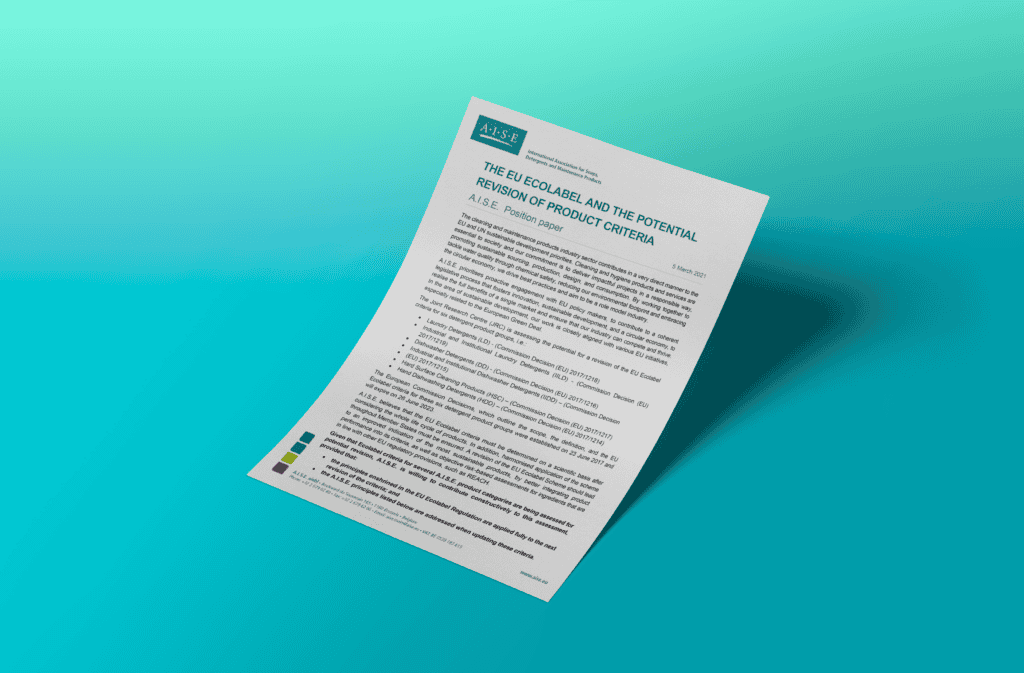
EU Ecolabel
How the framework works today
The EU Ecolabel is the European Union’s voluntary scheme promoting products with a reduced environmental impact throughout their lifecycle. It is managed at EU level and implemented by Member States, covering a wide range of product categories, including detergents and cleaning products.
For the detergents sector, the EU Ecolabel applies to multiple product groups and is based on scientifically defined criteria developed through consultation with stakeholders.
For detergents, environmental performance is closely linked to formulation and product use, including factors such as dosage, temperature and ingredient functionality, which are also addressed in the Chemicals section.
What is changing: ongoing revision and policy context
The EU Ecolabel criteria for detergents are currently under revision, with discussions focusing on:
- environmental performance requirements,
- restrictions on substances, and
- packaging and resource efficiency criteria.
This process is aligned with broader policy developments on sustainability labelling, environmental claims and consumer information, ensuring that the label remains relevant and credible. The latest revision of the EU Ecolabel criteria for detergents, concluded in May 2026, introduces updates aimed at reflecting technological progress and evolving policy priorities.
Of particular relevance to the cleaning and hygiene products sector are strengthened requirements on product formulation and environmental performance, updated packaging criteria, and enhanced consideration of resource efficiency across the product lifecycle. The revision also reinforces the role of the EU Ecolabel within the broader EU framework on sustainability labelling and environmental claims, ensuring continued alignment with evolving consumer information requirements and Single Market objectives.
The implementation of ESPR is also closely linked to broader EU initiatives aimed at strengthening industrial competitiveness and scaling sustainable solutions, including the Industrial Accelerator Act and the Circular Economy Act, which are expected to support the deployment of circular and resource-efficient product requirements across sectors.
Industry perspective and Detergents Europe’s work
Detergents Europe actively contributes to the revision of the EU Ecolabel by providing technical input, data and industry expertise.
From an industry perspective, the scheme should:
- remain based on full lifecycle assessment,
- be science-based and transparent, and
- ensure harmonised application across Member States.
The EU Ecolabel is seen as an important tool to support innovation, credible environmental claims and informed consumer choice, while maintaining consistency with other regulatory frameworks.
The development of ecolabel criteria should remain consistent with other regulatory frameworks, including those governing chemical classification, product safety and hazard communication, to ensure a coherent approach for products placed on the EU market.
These developments are also part of a broader policy context, where initiatives such as the Circular Economy Act and the Biotech Act aim to reinforce sustainable product frameworks and ensure the availability of innovative and sustainable ingredients, contributing to the effectiveness and credibility of sustainability labelling schemes.