
Policy Priorities / Sustainability & Circular Economy
Packaging and circular economy
How the framework works today
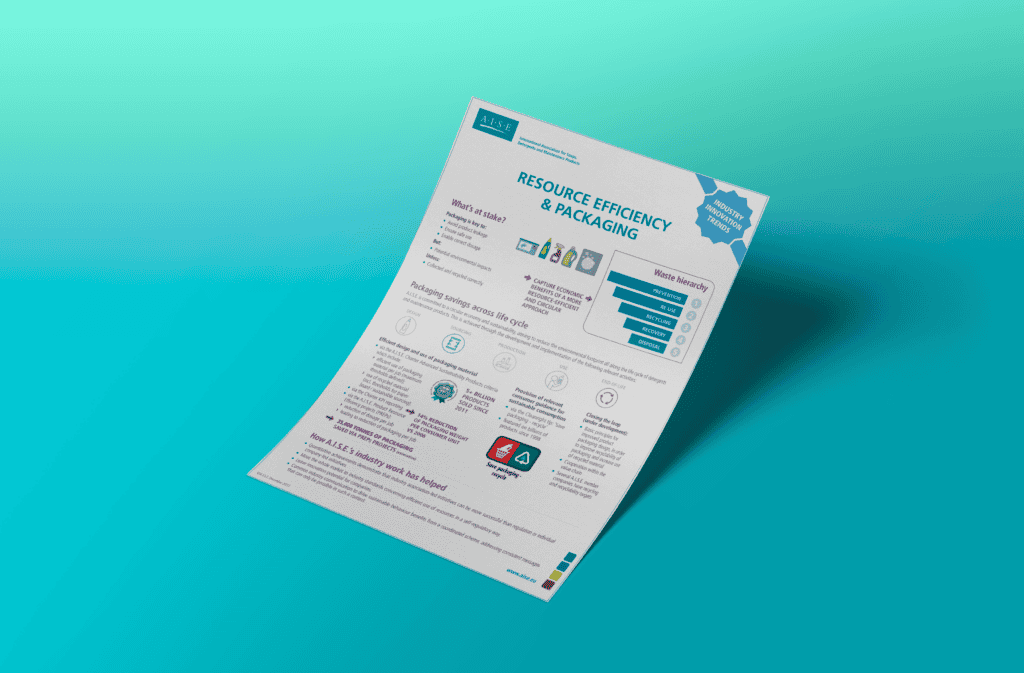
Packaging is a key component of the environmental footprint of detergents and cleaning products and is increasingly addressed through EU policy frameworks aimed at improving resource efficiency, recyclability and waste reduction.
For the sector, packaging requirements are closely linked to broader circular economy objectives, including material use, product design and end-of-life management. Packaging considerations are also closely connected to product safety requirements, for example in relation to child-resistant features and safe use communication for certain product formats, as described in the Chemicals section.
What is changing: packaging and circular economy framework
Recent policy developments, including the Packaging and Packaging Waste Regulation (PPWR) and wider circular economy initiatives, introduce new requirements. For our industry, the following are relevant:
- Strict recyclability criteria: By 2030, all packaging on the EU market must be recyclable. Packaging will be graded on a strict A to E scale, with the lowest-scoring packaging banned. Furthermore, packaging must be "recyclable at scale" by 2035.
- Mandatory recycled content targets: The regulation sets specific minimum percentages of post-consumer recycled (PCR) plastic that must be used in plastic packaging. These requirements step up progressively toward 2030 and 2040.
- Strict recyclability criteria: By 2030, all packaging on the EU market must be recyclable. Packaging will be graded on a strict A to E scale, with the lowest-scoring packaging banned. Furthermore, packaging must be "recyclable at scale" by 2035.
- Mandatory recycled content targets: The regulation sets specific minimum percentages of post-consumer recycled (PCR) plastic that must be used in plastic packaging. These requirements step up progressively toward 2030 and 2040.
- Waste reduction targets: The PPWR introduces EU-wide targets to cut overall packaging waste per capita by 5% by 2030, 10% by 2035, and 15% by 2040 (using 2018 as a baseline).
- Empty space reduction: The PPWR enforces design requirements that avoid unnecessary empty space in grouped, transport, and e-commerce packaging, reducing the volume of air shipped.
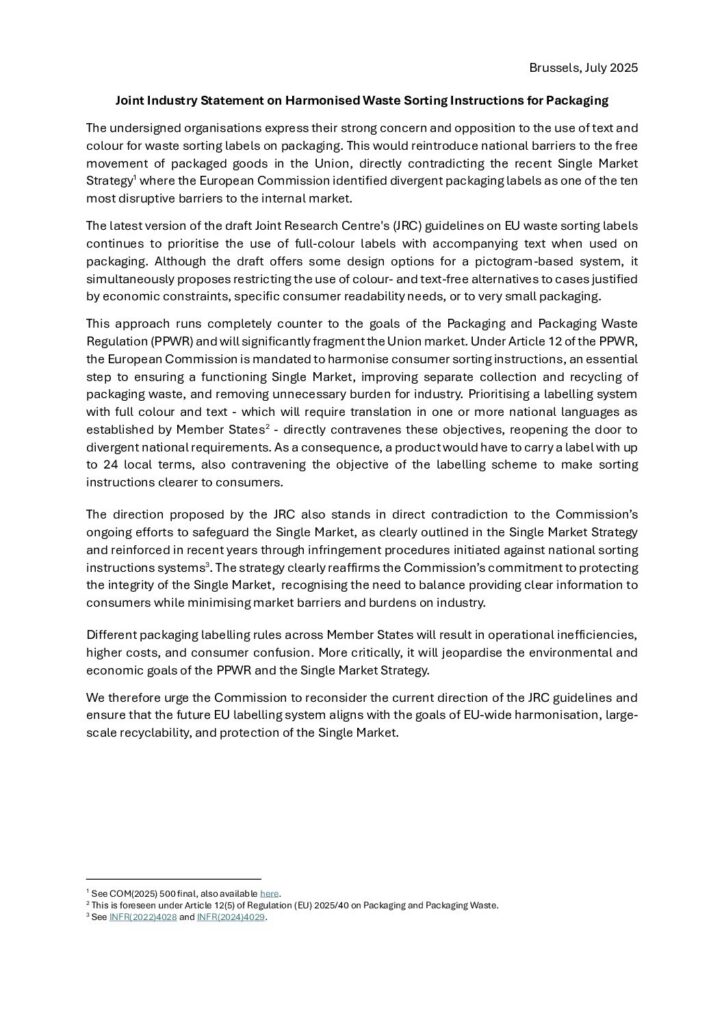
These measures aim to strengthen circular value chains and material flows, while improving consistency across the Single Market. These developments are expected to be further reinforced by the upcoming Circular Economy Act, which aims to improve the functioning of circular materials markets, including secondary raw materials, and support more harmonised rules across the EU. In addition, the Industrial Accelerator Act is expected to facilitate investment and scale-up of circular technologies and infrastructure, which are key to achieving packaging and recycling objectives in practice.
Industry perspective and Detergents Europe’s work
Detergents Europe contributes to packaging policy discussions by providing practical implementation experience and technical expertise.
Key priorities include:
- ensuring clear and harmonised rules across Member States,
- enabling access to high-quality secondary raw materials, and
- maintaining coherence with other frameworks such as ecodesign and chemicals legislation.
From an industry perspective, packaging requirements should support both environmental objectives and operational feasibility, avoiding unnecessary complexity and administrative burdens.
Close alignment between packaging requirements and chemicals legislation, including CLP rules on labelling and packaging, is essential to ensure that safety, sustainability and communication objectives are addressed in a consistent way.